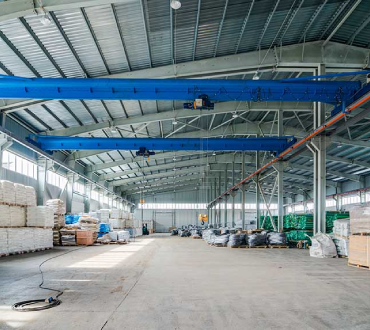
What is PEB?
PEB stands for Pre-Engineered Buildings. These buildings are pre-designed and constructed using metal structures and are fabricated at manufacturing facilities based on specific project requirements. PEB structures are widely used for industrial buildings, warehouses, hangars, workshops, factories, and commercial spaces.
Pre-Engineered Buildings are designed with optimized structural components that ensure faster construction, cost efficiency, and superior quality compared to conventional construction methods.
Classification of PEB Members
PEB structures are classified based on different structural members:
- Primary Members: Columns and Rafters
- Secondary Members: Purlins, Tie Rods, Eave Struts, Rake Angles, Girts
- Roofing and Cladding: Roof Panels and Wall Panels
Materials Used in PEB
The selection of materials in Pre-Engineered Buildings depends on the type of structural member. Different grades of steel are used for primary members, secondary members, bracing systems, and connection elements.
Material Selection & Specification
PEB structures utilize various steel grades for primary built-up sections, secondary members, bracing systems, and connecting components. Cold-formed Z and C sections are commonly used as secondary structural elements to support external cladding.
The built-up sections for flanges and webs are fabricated using high-grade steel plates such as IS:2062, ASTM A572 Grade 50, and Grade 345 MPa.
Primary Members
Primary members are the main load-carrying elements of a PEB structure. These include columns, rafters, and the main frame. The shape and size of these members vary depending on the application and structural requirements.
High-grade steel plates such as IS:2062, ASTM A572 Grade 50, and Grade 345 MPa are typically used to manufacture primary members due to their high load-bearing capacity.
Secondary Members
Secondary members include purlins, girts, and eave struts. These are cold-formed sections used at roof and wall intersections. Cold-formed Z sections are commonly preferred as they provide high strength with reduced weight.
Secondary members are generally manufactured from galvanized high-grade steel conforming to A653 Grade 50 or cold-formed steel with a minimum yield strength of 250–320 MPa.
Bracing Systems
Bracing systems connect the main columns and help stabilize the structure by distributing stress efficiently. Roof and wall bracing components are typically made from M.S rods conforming to ASTM A36 or ASTM A570 with a minimum yield strength of 250 MPa.
Roofing & Wall Sheeting
Roofing and wall cladding materials in PEB structures are usually roll-formed metal sheets. These materials are selected based on wind load requirements and environmental conditions.
Commonly used materials include galvanized coated steel conforming to ASTM A792M Grade 345B or aluminum sheets conforming to ASTM B209M with a tensile strength of up to 550 MPa.
Structural Connections
Structural connections play a vital role in maintaining the strength and stability of PEB structures. High-strength bolts and rivets are used to connect primary and secondary members.
For primary connections, bolt grades such as Gr 8.8, IS 3757 & IS 1367, or ASTM A325 are used. Secondary connections typically utilize Gr 4.6, IS 2367 & IS 1363, or ASTM A307.
Advantages of PEB
- Pre-designed and easy to fabricate structures
- Superior Quality Control and Quality Assurance
- Expandable, dismantlable, and reconstructable
- Low construction and maintenance cost
- Reduced construction time
- Large clear span up to 90 meters
- High resistance to natural disasters
Conclusion
Pre-Engineered Buildings are widely used across various industries due to their strength, flexibility, and cost-effectiveness. The selection of materials depends on the type of structural member, ensuring optimal performance and durability.
High-grade steel such as IS:2062, ASTM A572 Grade 50, and Grade 345 MPa is used for primary members, while galvanized steel with 250–320 MPa yield strength is commonly used for secondary Z and C sections.
Recent Post
-
Why are PUF Panel Sheets the best choice?
April 21, 2023
-
What is PEB?
April 21, 2023
-
Why is PEB always preferred for warehousing?
April 21, 2023
-
PEB Company in South India
April 21, 2023