Why is PEB always preferred for Warehousing?
In today’s construction trends, Pre-Engineered Buildings (PEB) are preferred over conventional concrete buildings for warehousing. Over recent years, PEBs have gained immense popularity due to their efficiency, flexibility, and cost-effectiveness.
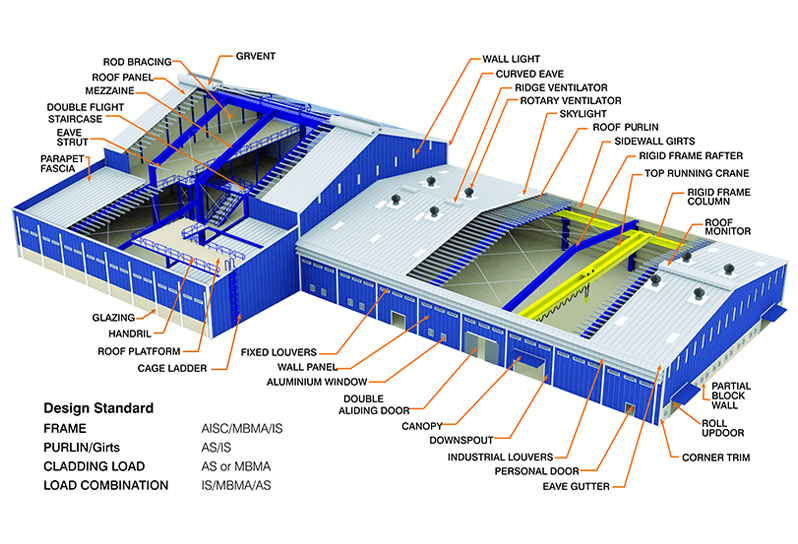
Warehousing facilities generally require large clear spans to store raw materials, heavy machinery, and large-sized components. PEB structures are designed using advanced engineering methods that allow for massive clear spans. In PEB warehouses, the clear span can go up to 150 meters in length and 90 meters in height, making them ideal for storing materials of various shapes and sizes.
Key Factors That Make PEB Reliable Over Concrete Structures
Several important factors make Pre-Engineered Buildings a more reliable option compared to conventional RCC structures for warehousing applications.
Clear Span
Clear span is one of the most critical requirements for warehousing. Warehouses are used to store raw materials, machinery, and structural scraps in various shapes and sizes.
The biggest advantage of PEB is that it eliminates the need for center columns and beams, which is not practically possible in conventional concrete structures. PEB warehouses can achieve a maximum length of 150–180 meters and a height of up to 90 meters, depending on structural design and material selection.
Cost Efficiency
Pre-Engineered Buildings are significantly more cost-efficient compared to concrete structures. The overall cost of a PEB warehouse depends on its size and material selection.
Major cost components include roofing and columns. When comparing various aspects such as labor cost, construction duration, and raw material usage, PEB structures are far more economical than conventional civil construction.
Construction Time
PEB structures use advanced design and manufacturing techniques. Many PEB components are pre-fabricated off-site, which minimizes on-site construction activities and ensures timely project completion.
The maximum construction time for a PEB warehouse is approximately 4 months, depending on the project requirements and location. In contrast, conventional civil structures usually take 8–12 months, influenced by labor availability, weather conditions, and construction complexity.
Reusable and Flexible
PEB structures are made of steel and iron materials, making them easy to fabricate, dismantle, relocate, and reassemble. This flexibility is especially useful when warehouse relocation or expansion is required.
The materials used in PEB are reusable, reconstructable, and rust-resistant. In contrast, concrete structures lack flexibility—errors in civil construction planning often lead to complete demolition, causing major financial and time losses.
Additionally, PEB structures generally do not require extensive environmental clearance as they generate less construction waste and pollution.
Material Quality
PEB structures are built using high-grade steel and iron materials that are corrosion-resistant and capable of withstanding various structural stresses.
PEB construction follows American Standards (AISC), Indian Standards (IS), and also incorporates BS and DIN codes for material selection. Both primary and secondary members are manufactured using high-grade steel plates and cold-formed steel sections to ensure durability and strength.
Conclusion
Modern construction techniques have revolutionized industrial infrastructure development, enabling faster, smarter, and more efficient solutions. Among various construction methods available for warehouses, Pre-Engineered Buildings stand out as the most reliable option.
PEB warehouses offer superior strength, large clear spans, reduced construction time, flexibility, and cost efficiency. These advantages make PEB the best-suited construction solution for warehousing applications in today’s industrial landscape.
Recent Post
-
Why are PUF Panel Sheets the best choice?
April 21, 2023
-
What is PEB?
April 21, 2023
-
Why is PEB always preferred for warehousing?
April 21, 2023
-
PEB Company in South India
April 21, 2023